Famous Characters Who Wore Masquerade Masks: From Venetian Theatre to the Screen
October 16, 2026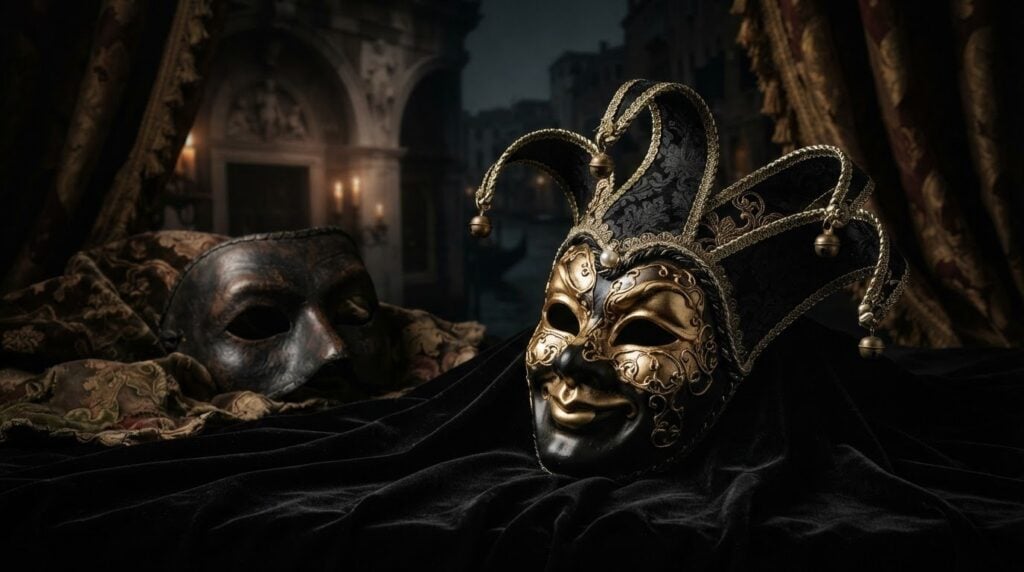
What does the familiar jester mask tell us about theatre, and what can it tell us about the people who entertained rulers? The history of the jester mask isn’t a straight line from medieval court to modern masquerade. Its image took shape through changing traditions, and its bells, points and motley patterns don’t describe every historical fool.
It’s easy to blend court jesters with Harlequin and today’s costume imagery, but they belong to distinct chapters. Court jesters entertained noble households, while the masked characters of 16th-century Italian Commedia dell’Arte brought theatrical trickery to the stage. Arlecchino, or Harlequin, was a comic servant whose costume helped shape the colourful jester look. His traditional mask, however, was black. In this article, we’ll trace those strands from court entertainment to Italian theatre and masquerade, separating historical context from later convention. You’ll discover what a jester mask can suggest about wit, performance and shifting identities, and what it can’t prove about real jesters. The result is a richer view of a playful image that still lends Venetian masquerade its theatrical sparkle.
Key Takeaways
- The history of the jester mask is a story of evolving imagery, not one unchanging design.
- See how Arlecchino and Commedia dell’Arte helped shape the jester’s theatrical look.
- Learn to distinguish historical clues from familiar motifs such as bells, pointed caps and patterned costumes.
- Discover what a jester mask can suggest about performance and masquerade, and what it cannot confirm about real jesters.
- Explore how the theatrical legacy lives on in today’s artisan Jester and Jolly masks.
What Is the History of the Jester Mask, and Who Was the Jester?
A jester mask is a visual emblem of the comic trickster, but it isn’t a reliable portrait of every entertainer once called a jester or fool. The history of the jester mask is best understood as a gradual meeting of courtly entertainment, theatrical characters and later costume imagery. Those strands overlap, but they aren’t interchangeable: someone who entertained a ruler was not automatically a masked stage character.
That distinction matters because the pointed cap, bells and bold patterns familiar today can make the past seem tidier than it was. Historical records describe people and performances in particular settings, not one universal jester uniform. A useful guide is this: the jester was a historical role, while the jester mask is an image shaped by performance and later tradition.
Court jesters: entertainers, commentators and companions
In European courts, jesters could entertain through verbal wit, music, comic behaviour or performance. Some were valued as companions as well as entertainers. Their duties varied, and the evidence differs between periods and households, so it’s more accurate to picture a range of roles than one fixed job description. The wider history of jesters offers useful context for how the role appeared across different societies.
Nor did the label “fool” mean that someone necessarily wore a mask. It could describe a recognised role or persona, while clothing and performance choices depended on the individual context. A modern jester costume may evoke the court, but it shouldn’t be treated as proof that every court entertainer looked that way.
From historical entertainer to recognisable mask figure
The mask figure emerged as different traditions were reinterpreted together. Courtly fools supplied one strand; theatre brought characters with distinct costumes and performance styles; later costume and masquerade imagery made selected motifs easier to recognise. The result is a vivid visual shorthand, rather than a single design with one securely established origin date.
Arlecchino, better known in English as Harlequin, belongs to the theatrical strand. He was a specific character in Italian Commedia dell’Arte, not another name for every jester who entertained a noble household. His influence helps explain why theatrical trickery and jester imagery are so often linked, a connection explored in the next section.
How Arlecchino and Commedia dell’Arte Shaped Jester-Mask Imagery
The theatrical thread leads to Commedia dell’Arte, an Italian performance tradition built around recurring character types, lively physical acting and improvisation. Its masked figures were not portraits of particular court entertainers. They belonged to a stage ensemble, where recognisable costumes and masks helped audiences distinguish one character from another.
Who is Arlecchino in Commedia dell’Arte?
Arlecchino, known in English as Harlequin, was one of the Zanni, the comic servant characters in the tradition. Associated with agility, acrobatic movement and trickery, he was a very different figure from a jester employed at court. His costume is commonly described as developing from patched or ragged clothing into the colourful, diamond-patterned motley now strongly associated with Harlequin.
His traditional mask was black, a detail that complicates the familiar modern image of a bright, bell-trimmed jester face. The exact route by which Arlecchino’s costume and mask developed should be treated cautiously. Precise claims about first appearances or a single moment of change need checking against specialist theatre histories.
How a stage character became a mask-making reference
As Arlecchino became a memorable theatrical figure, his silhouette and costume offered artists and mask-makers a rich source of inspiration. A later masquerade mask might echo the character through dark features, motley patterns or a playful expression, while adapting those details for a new setting. This visual conversation helps explain the jester’s enduring theatrical flair without reducing every version to one template.
A mask inspired by Arlecchino shows a character’s influence, not that historical jesters generally wore that design. Stage conventions show how performers represented a role, while evidence of everyday dress or court practice must come from separate historical records. Similar motifs can travel between theatre, art and costume without proving that they began in the same place.
The history of the jester mask is therefore partly a history of interpretation: theatre supplied memorable character imagery, and later makers reshaped it for masquerade. For a present-day expression of that playful tradition, explore Venetian Jester and Jolly masks, where theatrical references meet artisan mask-making.

Jester-Mask Details: Historical Clues, Theatre and Later Convention
A pointed cap, tiny bells and diamond-patterned clothing make a jester instantly recognisable today. But familiar doesn’t mean universal: these motifs belong to a visual language assembled across different settings, not a single design worn by every historical fool. The history of the jester mask becomes clearer when we separate evidence about entertainers from theatrical costume and modern shorthand.
The jester cap, bells and patterned costume
The three-pointed cap and jingling bells are enduring jester motifs, but their familiarity shouldn’t be mistaken for proof that all jesters wore them. Claims that the points specifically represent animal ears or a tail should be presented as explanations found in later tradition, not as settled accounts of medieval dress. Likewise, Arlecchino’s patterned costume supports a theatrical association between motley and the character; it doesn’t establish that pattern as a uniform for court entertainers.
Dates for the appearance of individual details need careful sourcing. Without firm evidence, it’s more accurate to describe a motif as a later convention than to assign it a precise medieval origin.
Jester, fool and Harlequin: related but not interchangeable
“Jester” and “fool” can refer broadly to entertainers or recognised roles in particular historical settings. Harlequin, by contrast, names a specific theatrical character. Modern masks may blend the cap and bells associated with jesters with Arlecchino-inspired patterns, creating a lively design that draws on more than one tradition. That mix can be charming, but it isn’t evidence of one standard historical look.
Explore Jester and Jolly masks for an artisan interpretation of these theatrical motifs, where familiar details become part of a distinctive masquerade design.
The Jester Mask Today: A Living Link to Theatrical Tradition
The jester mask has travelled from the varied world of historical entertainers through theatre’s vivid character types and into modern masquerade. Today’s designs often bring these threads together, using recognisable details to create a playful, dramatic impression. That visual mix is part of the pleasure, provided we remember that a contemporary jester-inspired mask needn’t reproduce one historical original.
Why the jester remains a memorable masquerade character
Jester imagery arrives with a ready-made sense of performance: a lively silhouette, a mischievous expression or a flourish of colour can suggest a character before a word is spoken. Theatrical traditions such as Commedia dell’Arte helped keep these figures in circulation, while costume and masquerade give them fresh settings. For an event, that makes the jester a spirited choice, whether you favour a subtle nod to the stage or a more exuberant look.
History adds texture without prescribing a costume. Knowing that court entertainers and Arlecchino belonged to distinct contexts lets you enjoy the references without treating every bell or patterned detail as a historical fact.
Choosing a jester-inspired mask with historical awareness
Think of the mask as an interpretation rather than a museum-style reconstruction, unless it’s specifically presented as one. Just Posh Masks’ Jester and Jolly collection offers a contemporary way to enjoy the character’s theatrical appeal. Individual designs can draw on familiar motifs without claiming to represent every jester across history. Choose a style that suits your event and the impression you want to make, whether elegant, playful or boldly theatrical.
For fit reassurance, the 14 Day Home Approval lets you try a mask at home and return it if it doesn’t fit. Returns for a refund must be made within 30 days of delivery. Just Posh Masks’ Venetian masks are handmade, so hand-painted details may differ slightly from the image, while the colours will match. Explore handcrafted masquerade masks for designs that bring historical and theatrical references into the present.
The history of the jester mask is still being retold through imaginative designs, each offering a distinctive finishing touch for a night of disguise and celebration. For practical styling ideas before your event, continue with the guide to wearing a masquerade mask.
Let Theatrical Heritage Inspire Your Next Masquerade
The history of the jester mask invites us to see masquerade as more than a finishing touch: it’s a chance to step into a character, play with familiar motifs and make a little theatrical magic your own. You needn’t recreate a specific period to enjoy that heritage. Choose a mask that suits your occasion, whether its details are subtle or delightfully exuberant.
For a contemporary Venetian interpretation, the Jolly Jester Double is a Colombina mask with headdress bells and pearls on a gold stick. It brings a playful flourish to an elegant silhouette and shows how artisans can draw on theatrical references without claiming to reproduce one historical original.
Let your sense of occasion guide the choice, and enjoy the moment when a crafted detail transforms an outfit into a memorable entrance. Explore Just Posh Masks’ handcrafted masquerade masks and find an expressive finishing touch for your next celebration. Stand out from the crowd with a little theatrical spirit.
Frequently Asked Questions
Were medieval jesters always employed by royal courts?
No. Some jesters entertained rulers and noble households, while others performed as travelling entertainers, including at fairs. “Jester” covers varied roles rather than one fixed occupation tied exclusively to royal service. An entertainer performing for a fair crowd belonged to a different setting from one attached to a noble household. Accounts vary, so it’s best not to assume every performer had the same employer or duties.
Did every jester wear a cap with bells?
No reliable basis supports treating a bell-trimmed cap as universal jester clothing. The pointed cap and its bells are familiar motifs, but a memorable costume feature doesn’t prove that every historical entertainer wore it. An illustration showing a cap tells you about that particular depiction, not automatically about jesters across other courts or periods. Treat the motif as a clue to an image, not a universal dress rule.
Were historical jesters’ faces usually covered by masks?
There’s no good reason to assume they were. The word “fool” or “jester” identifies a role in a particular context; it doesn’t establish that the performer concealed their face. A mask shown in a theatrical or later costume image may belong to that representation rather than everyday court entertainment. The history of the jester mask is therefore not evidence that face-covering was standard among historical jesters.
What is the difference between a jester and Arlecchino?
A jester was a broad kind of entertainer or court role, while Arlecchino was a named character in Italian Commedia dell’Arte. Think of the difference between a job description and a character in a play: they may share comic qualities, but they aren’t interchangeable. Arlecchino’s stage costume and mask conventions belong to theatre, so they shouldn’t be used as a template for every real-life jester.
Why are bells associated with jester costumes?
Bells became a recognisable feature of jester imagery, often pictured on the points of a cap. Their presence in a costume or illustration helps signal the character to an audience, but it doesn’t establish that all jesters wore bells or explain exactly when the association began. When reading an image as historical evidence, check its date and context rather than treating the bells as proof of a universal custom.
Is a modern jester mask a historically exact reproduction?
Usually, it’s better understood as a contemporary interpretation unless it comes with specific evidence describing it as a reconstruction. A modern design might combine a theatrical reference, such as Harlequin-inspired patterning, with bells or other familiar costume details. That can make a striking masquerade mask, but the combination doesn’t prove it reproduces one historical original. Look for clear documentation before treating any design as a precise historical model.
Disclaimer
This article was created with the assistance of AI and carefully reviewed by the team at Just Posh Masks to ensure accuracy and relevance. We combine automated insights with our experience in premium face coverings and accessories to provide helpful, trustworthy guidance.